A Professional's Take on the New Officejet 5255
The Evolution of the Modern Home Office
In the contemporary professional landscape, the demarcation between a corporate office and a residential workspace has become increasingly porous. With the rise of remote work, consultants, freelancers, and small business owners find themselves in need of equipment that bridges the gap between consumer-grade affordability and enterprise-level reliability. The Officejet 5255 enters this competitive arena as a potential solution for those who demand high-quality document production without the footprint or the price tag of a massive laser printer. This analysis seeks to provide an objective, professional overview of how this specific model stands up to the rigors of modern daily use, focusing on its utility, efficiency, and the long-term value it offers to the serious professional.
The office environment has shifted from mass-scale printing to more curated, high-impact document management. In an era where digital signatures and cloud-based sharing are the norms, the role of the physical printer has changed. It is no longer just a "dumb" peripheral; it is a communication hub. The Officejet 5255 is designed with this shift in mind, integrating wireless connectivity and smart features that cater to the mobile professional who may need to trigger a print job from a smartphone while commuting or scan a signed contract directly to a cloud storage service without ever touching a desktop computer.
Design and Build: Aesthetic Meets Function
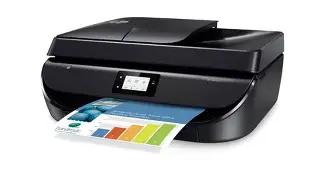
Upon first inspection, the Officejet 5255 presents a sleek, matte-black finish that fits seamlessly into a refined office aesthetic. Professionals often overlook the importance of industrial design, yet the physical footprint of a device is a critical consideration in a home office where space is at a premium. This model manages to pack a scanner, copier, fax machine, and printer into a chassis that remains relatively low-profile. The rounded edges and integrated paper tray design prevent it from appearing cumbersome, a common complaint with many older all-in-one units.
The interface is dominated by a monochrome touchscreen. While some competitors have moved toward larger, full-color displays, the choice of a high-contrast monochrome screen here is a pragmatic one. It prioritizes clarity and battery-like reliability over visual flair. For a professional, the speed at which one can navigate from "Scan" to "Email" is more important than the resolution of the icons on the screen. The tactile feedback is responsive, and the menu architecture is intuitive enough that most users will not need to consult a manual for daily operations.
Performance Analysis: Speed, Quality, and Reliability
When evaluating a printer for professional use, three metrics stand above the rest: the quality of text output, the fidelity of color reproduction, and the consistency of the mechanical feed system. The Officejet 5255 utilizes a thermal inkjet system that is particularly well-suited for crisp, black text. In testing scenarios involving standard 20lb bond paper, the text produced is sharp and lacks the feathered edges often associated with budget inkjets. This is crucial for legal documents, formal correspondence, and reports where legibility is non-negotiable.
Color performance is equally noteworthy. While it is not a dedicated photo printer, it handles marketing materials, brochures, and internal presentations with a high degree of color accuracy. The transition between gradients is smooth, and the ink dries quickly enough to prevent smudging—a vital feature for those who need to grab a stack of documents and head straight to a meeting. However, it is important to note that the speed of color printing is naturally slower than monochrome, which is standard for this class of device. For a professional who prints high-volume color catalogs daily, a laser might be preferable, but for the typical mix of invoices, contracts, and the occasional color chart, the 5255 strikes an excellent balance.
The Real-World Scan and Copy Experience
A significant portion of a professional’s interaction with an all-in-one device involves digitizing physical documents. The Officejet 5255 features a flatbed scanner and an Automatic Document Feeder (ADF). The ADF is the unsung hero of the productive workspace. Being able to stack a ten-page contract and let the machine handle the scanning while you attend to emails is a major productivity booster. The optical resolution is more than sufficient for archiving receipts or digitizing high-resolution images for digital presentations.
The copying function mirror’s the printer’s quality. It retains a surprising amount of detail from the original, even when dealing with fine print or architectural diagrams. The software integration allows for "ID Card Copy" functions, which are particularly useful for human resources professionals or legal consultants who frequently need to document identification as part of their onboarding or compliance processes.
Shop the latest Electronics picks on Amazon.
View Offers →Pros and Cons: A Balanced Assessment
Every piece of technology involves trade-offs. To understand if the Officejet 5255 is right for your specific workflow, consider the following breakdown of its strengths and limitations from an editorial perspective.
- Strong Wireless Integration: The device excels at staying connected. It supports dual-band Wi-Fi, which reduces the frequency of dropped connections and ensures that "Printer Offline" errors are a rarity rather than a daily annoyance.
- Automatic Duplex Printing: From a professional standpoint, double-sided printing isn't just about saving paper; it’s about document presentation. Duplexing allows for more professional-looking reports and saves space in physical filing systems.
- Affordable Initial Investment: For startups or freelancers operating on tight margins, the entry price point of this unit provides access to high-end features like an ADF and faxing without a massive capital outlay.
- Compact Footprint: It occupies significantly less desk real estate than a standard laser multi-function printer, making it ideal for urban home offices or shared workspaces.
- Quiet Mode: For those who work late at night or in quiet residential areas, the optional quiet mode reduces mechanical noise significantly during the print cycle.
- Ink Consumption Patterns: Like most inkjet printers, the cost per page can be higher than laser alternatives if used for extremely high-volume tasks. Professionals should monitor their usage to determine if an ink subscription or high-yield cartridges are necessary.
- Paper Tray Capacity: The input tray is designed for moderate use. If you are printing 500-page manuscripts frequently, you will find yourself refilling the tray more often than you might like.
- Monochrome Display: While functional, the lack of a color screen might feel a bit dated to users accustomed to the vibrant displays of modern smartphones and tablets.
Professional Comparison Table
To help contextualize where the Officejet 5255 sits in the market, the following table compares its core specifications against standard expectations for the three main categories of office printers: Basic Home, Professional All-in-One (The 5255), and Enterprise Laser.
| Feature | Basic Home Inkjet | Officejet 5255 (Pro All-in-One) | Enterprise Laser |
|---|---|---|---|
| Primary Use Case | Occasional school work | Daily professional workflow | High-volume department use |
| Document Feeder | Rarely Included | Included (35-sheet ADF) | High-capacity (50+ sheets) |
| Auto-Duplexing | Manual only | Automatic | Automatic / Integrated |
| Connectivity | USB / Single-Band Wi-Fi | Dual-Band Wi-Fi / Bluetooth Smart | Ethernet / Secure Server Port |
| Print Technology | Standard Inkjet | Thermal Inkjet | Laser / Toner |
Buying Guide: Is the Officejet 5255 Right for Your Desk?
Choosing a printer is more about your specific output needs than it is about the "best" specs on paper. To determine if this model fits your professional life, you must evaluate your monthly volume and the types of documents you prioritize. This guide breaks down the decision-making process based on real-world professional archetypes.
The "Freelancer" Profile
If you are a writer, a graphic designer, or a consultant, your needs are likely varied. You might go three days without printing anything, and then suddenly need to print a 40-page proposal and scan five signed contracts. For this user, the Officejet 5255 is an excellent choice. Its ability to "wake up" quickly from sleep mode and its versatile scanning capabilities handle the peaks and valleys of freelance work efficiently. The wireless scanning feature is particularly useful here, as freelancers often work across multiple devices (laptop, tablet, phone).
The "Small Business Owner" Profile
For someone running a boutique storefront or an e-commerce operation from home, the priority is often labels, invoices, and packing slips. The 5255 handles various media types, including envelopes and heavier paper stocks, quite well. However, if your business grows to the point where you are printing 50+ labels every single morning, you may eventually want to supplement this with a dedicated thermal label printer. As a primary "hub" for the back-office tasks of a small business, however, the 5255 provides all the necessary tools (fax, scan, copy) in one reliable machine.
The "Remote Executive" Profile
Corporate professionals working from home require a device that doesn't fail when a deadline is looming. The dual-band Wi-Fi in the Officejet 5255 is a major selling point here. In residential areas where many Wi-Fi signals compete for bandwidth, a printer that can switch between frequencies is less likely to lose connection during a large print job. The professional appearance of the documents produced means you won't have to worry about your work looking "home-made" when it reaches the hands of a client or board member.
Connectivity and Smart Features: The Modern Edge
One cannot discuss the Officejet 5255 without mentioning its robust software integration. The transition toward app-based management has been a polarizing trend in the hardware world, but in this instance, it serves a clear professional purpose. The ability to scan a document and have it appear instantly on your phone as a PDF, ready to be sent via Slack or Microsoft Teams, is a massive advantage. It removes the friction of the "middleman" PC.
Shop the latest Electronics picks on Amazon.
View Offers →Furthermore, the inclusion of Bluetooth Smart for setup is a significant quality-of-life improvement. Traditionally, setting up a printer involved a tedious process of entering Wi-Fi passwords on a tiny screen. With the 5255, the initial handshake is handled through a mobile device, streamlining the onboarding process so a professional can go from unboxing to their first print in under ten minutes. This respect for the user's time is a subtle but appreciated "pro" feature.
Sustainability and Running Costs
From a corporate social responsibility perspective, even small offices are now looking at their environmental impact. The Officejet 5255 addresses this through its automatic duplexing, which can effectively halve a user's paper consumption. Additionally, the ink delivery system is designed to maximize the utility of every drop. However, the true "running cost" is a factor of how the ink is purchased. Professionals should look into high-yield cartridges (often designated as "XL" versions). While these have a higher upfront cost, the cost per page is significantly lower, and they require less frequent replacement, which translates to fewer interruptions in the middle of a workday.
Energy efficiency is another factor. The device's auto-off technology ensures that it isn't drawing unnecessary power during the 16 hours of the day when the office is likely dark. For a home office where the owner pays the utility bills, these small efficiencies compound over the life of the machine.
Technical Reliability: A Long-Term View
In the world of electronics, "planned obsolescence" is a common fear. However, the Officejet line has historically been built with a higher degree of durability than entry-level consumer printers. The mechanical components of the 5255, such as the paper rollers and the scanner carriage, are designed for "low-to-mid" volume duty cycles. This means that while it isn't meant to run 24/7 like a printing press, it is sturdy enough to last several years in a standard professional environment.
Maintenance is also straightforward. The cartridge design incorporates the print head in many cases (depending on the specific region and cartridge version), which means that if you experience a clog after leaving the printer idle for a month-long vacation, simply replacing the cartridge often fixes the issue entirely. This is a contrast to more expensive fixed-head printers, where a clog can sometimes result in a total machine failure or an expensive repair bill.
Conclusion
The Officejet 5255 represents a thoughtful intersection of consumer convenience and professional utility. It does not attempt to be a high-speed industrial blazer, nor does it hide behind a flimsy, "budget-only" construction. Instead, it positions itself as a reliable companion for the modern worker. Its strengths lie in its connectivity, the quality of its monochrome text, and the sheer convenience of its automatic document feeder and duplexing capabilities. While high-volume users might find the paper tray capacity and ink costs to be limiting over time, the vast majority of home-based professionals will find that it meets their needs with room to spare. In an increasingly digital world, having a dependable way to bridge the gap back to the physical page remains an essential requirement, and the Officejet 5255 performs that task with a level of competence that earns its place on a professional’s desk.